That dull ache between your shoulder blades by 3 PM isn’t random — it’s usually the slow, cumulative cost of hours spent hunched slightly forward, shoulders creeping toward your ears, without you ever noticing it happening in real time. Most of us have no idea how our posture actually drifts over the course of a workday, because nobody’s watching it — until now.
AI-based ergonomic posture analysis uses ordinary cameras and computer vision to do exactly that: quietly observe how you sit or stand, flag the moments your alignment slips, and nudge you toward correcting it before stiffness turns into chronic pain. No wearable sensors, no clinical equipment — just a webcam and an algorithm that actually understands what good posture looks like. Here’s how it works and why it’s becoming a serious tool for workplace health.
What Is AI-Based Posture Analysis?
At its core, this technology combines a camera with computer vision software trained to recognize the human body’s key points — shoulders, neck, spine, hips — and continuously assess how they’re aligned relative to each other. Instead of a one-time posture check from a physical therapist or an occasional reminder app, it works continuously, catching the gradual slouch that builds up over hours rather than the obvious slump you’d notice yourself.
The result is real-time, objective feedback on something most people have historically had to guess about.
Why AI Beats Traditional Posture Monitoring
Traditional approaches to posture correction rely on manual observation — a colleague noticing you’re slouching, a periodic ergonomic assessment, or bulky wearable devices that need to be worn correctly and consistently to work at all. These methods share a common weakness: they’re occasional, not continuous, so they miss the subtle posture drift that happens minute by minute.
AI-based systems close that gap. They monitor continuously without requiring any special equipment on your body, catch small misalignments a human observer would likely miss, and deliver feedback immediately rather than after damage has already accumulated. Over time, this also reduces reliance on reactive clinic visits, since problems get caught and corrected well before they become painful enough to need professional treatment.
The Computer Vision Techniques Behind It
Pose Estimation
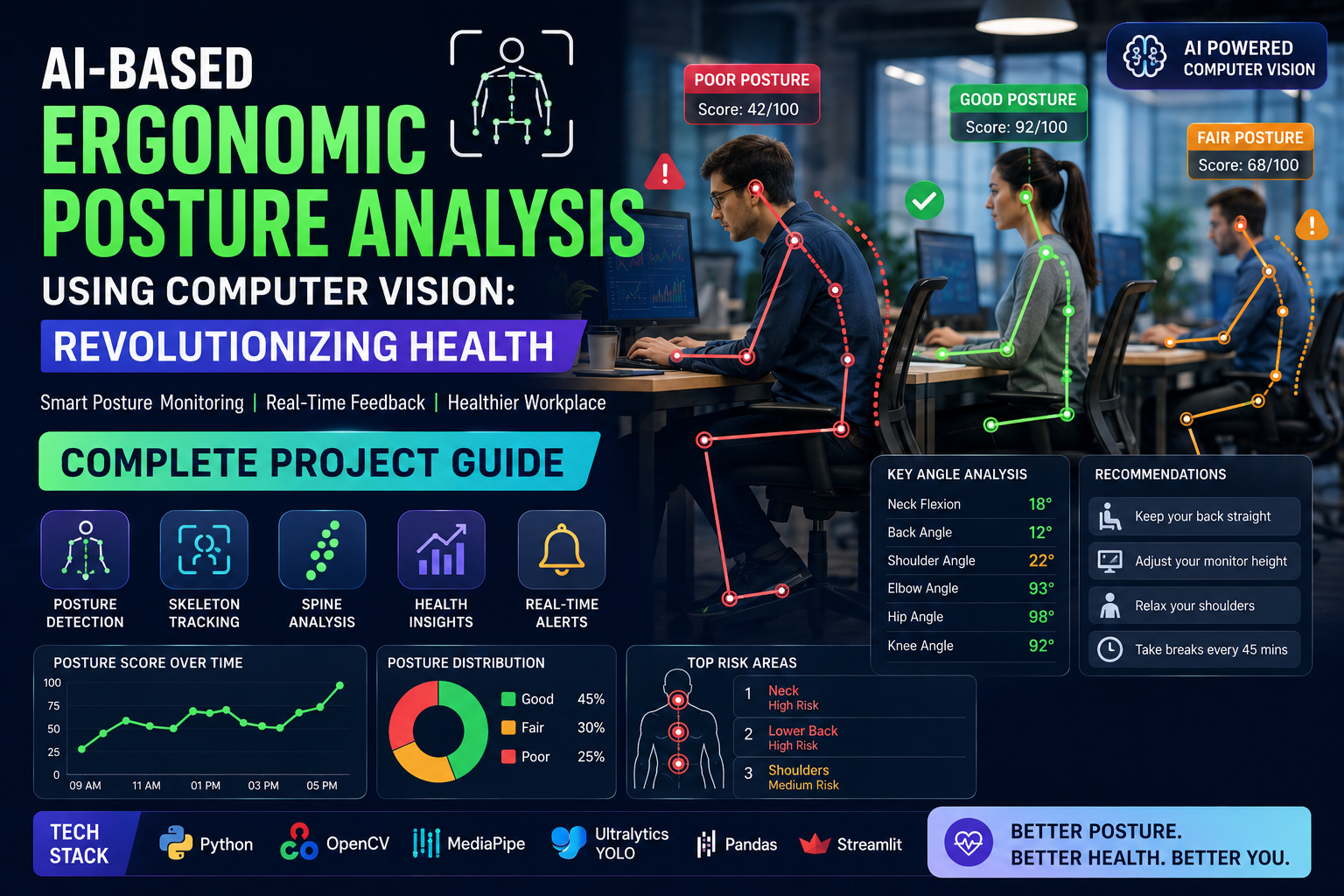
The foundational technique here is pose estimation — deep learning algorithms that map key body joints (shoulders, elbows, hips, neck) from a video feed and connect them into a skeletal representation of your posture. Modern pose estimation models are robust enough to work accurately even in cluttered backgrounds or imperfect lighting, which is what makes deploying this in a normal home or office setting practical rather than requiring a controlled studio environment.
Real-Time Detection
Once the skeleton is mapped, the system needs to process it fast enough to give feedback while it’s still useful — meaning within seconds, not after the fact. Efficient real-time algorithms make this possible on everyday devices like laptops and smartphones, so you don’t need specialized hardware to benefit from it.
The Technical Challenges
None of this is trivial to get right. Lighting changes can distort image quality, different body shapes and clothing complicate consistent detection, and occlusion — when part of the body is blocked from view — can throw off the analysis entirely. Reliable systems have to be engineered to handle all of this gracefully, which is a big part of why posture-tracking AI has taken real engineering effort to mature into something dependable.
How Posture Gets Measured
Good posture isn’t a vague concept to these systems — it’s quantified. The core indicators typically tracked include whether the head stays centered over the shoulders, whether the shoulders remain level and relaxed rather than rounded forward, whether the spine maintains its natural curve instead of collapsing into a slouch, and whether the hips stay aligned with the knees and feet.
To measure this precisely, the software calculates specific angles — neck tilt, shoulder slope, spinal curve — from the camera feed, essentially converting your posture into a set of numbers that can be scored and tracked over time. A lower score flags an area that needs correction, and because the system logs data continuously, it can also reveal longer-term patterns: the specific hour of your day when your posture reliably breaks down, for instance, which is often more useful than any single snapshot.
Why Posture Actually Matters for Your Health
It’s easy to dismiss posture as a minor comfort issue, but the downstream effects are more serious than they get credit for. Poor posture places ongoing strain on muscles and joints, commonly showing up as back, neck, and shoulder pain, and over time contributing to headaches and general fatigue. It can also restrict blood flow, and — less obviously — compress internal organs enough to affect breathing and digestion.
Sustained poor posture is also one of the primary contributors to musculoskeletal disorders (MSDs), which develop from repetitive strain over months or years rather than a single bad day at the desk. Catching problematic patterns early, before they calcify into chronic pain, is exactly where continuous AI monitoring has an edge over occasional manual checks — it flags the risky pattern while it’s still just a pattern, not yet an injury.
What Goes Into Building One of These Systems
Hardware and Software
On the hardware side, these systems typically just need a standard webcam or depth camera — nothing exotic. The heavier lifting happens in software: computer vision algorithms detect body key points, machine learning models learn to recognize problematic posture patterns specific to how a real person sits (not just a textbook example), and the resulting feedback gets delivered through alerts or a simple visual interface. For this to be genuinely useful day to day, the software needs to run fast and reliably on ordinary computers or smartphones — not require a dedicated workstation.
Handling Data Privacy Properly
Because this technology is quite literally watching you, privacy has to be treated as a core design requirement, not an afterthought. Well-built systems collect only what’s necessary for the analysis itself, avoid storing sensitive personal data beyond what’s needed, encrypt data both in transit and at rest, and give users real visibility and control over what’s being shared. Transparent privacy practices aren’t just good ethics here — they’re what determines whether people actually trust and adopt the tool.
Combining with Wearables
Some systems pair camera-based posture tracking with data from wearables like smartwatches or fitness bands, fusing movement and position data from both sources for a more complete picture. This combination can catch subtle posture shifts that camera data alone might miss, and wearables add the option of physical alerts — a gentle vibration, for instance — that work even when you’re not looking at a screen.
Where This Technology Is Already Being Used
Workplace Ergonomics: Offices and factories are using posture analysis to catch problematic habits before they turn into injuries like back pain or repetitive strain conditions. The resulting data also informs smarter workspace and equipment design, and can meaningfully reduce sick days tied to posture-related discomfort.
Healthcare and Rehabilitation: Clinics and hospitals use posture tracking to monitor patient recovery after injury or surgery, giving therapists objective, continuous feedback on progress rather than relying solely on periodic in-person assessments. It also enables remote monitoring, letting patients do prescribed exercises correctly at home with the system checking their form.
Fitness and Personal Wellness: Fitness apps and trainers use posture analysis to check exercise form in real time, helping people avoid injury and get more out of each workout — essentially offering a layer of coaching feedback even when no trainer is physically present.
Where This Is Headed
More accurate AI models: As these systems train on larger, more diverse datasets covering different body types and sitting styles, detection accuracy keeps improving — and increasingly, models are moving toward predicting posture problems before they fully develop, not just flagging them after the fact.
More natural interaction: Expect interfaces to get simpler over time, potentially incorporating voice or gesture-based interaction alongside visual feedback, with recommendations becoming more personalized to an individual’s specific habits rather than generic advice.
Wider accessibility: As more everyday devices — smartphones, standard webcams — become capable of running this kind of analysis, and cloud-based processing lowers the hardware bar even further, posture monitoring is likely to become something available to far more people without any specialized equipment at all.
Getting Started
If you’re curious about trying this yourself, the barrier to entry is lower than you’d expect — many posture-tracking tools now run on nothing more than a laptop webcam. Start by simply observing what the data shows about your own patterns before trying to fix anything; often just seeing when and how your posture slips is enough to start correcting it naturally. From there, small adjustments — monitor placement, chair height, more frequent movement breaks — tend to compound into meaningful relief over weeks, not months.
Final Thoughts
AI-based ergonomic posture analysis turns something we’ve traditionally had almost no visibility into — how our bodies actually behave through a long workday — into clear, continuous, actionable feedback. It doesn’t require expensive equipment or a trip to a specialist to get started, just a willingness to let a camera show you what you’ve been missing.
Good posture isn’t about sitting perfectly straight every second of the day — nobody manages that. It’s about catching the drift before it becomes pain, and that’s precisely the kind of quiet, continuous attention AI is well suited to provide.